The law of large numbers
Why Averages Get Smarter With More Data
If you’ve ever wondered why companies love “big data,” why pollsters need large sample sizes, or why casinos always seem to win in the long run, you’ve quietly bumped into one of the most powerful ideas in statistics: the Law of Large Numbers.
Despite the intimidating name, the idea behind it is beautifully simple—and surprisingly intuitive.
What Is the Law of Large Numbers?
The Law of Large Numbers (LLN) says:
The more times you repeat a random experiment, the closer your average result gets to the true long‑term average.
Think of it as the universe slowly revealing its real probabilities—but only after enough tries.
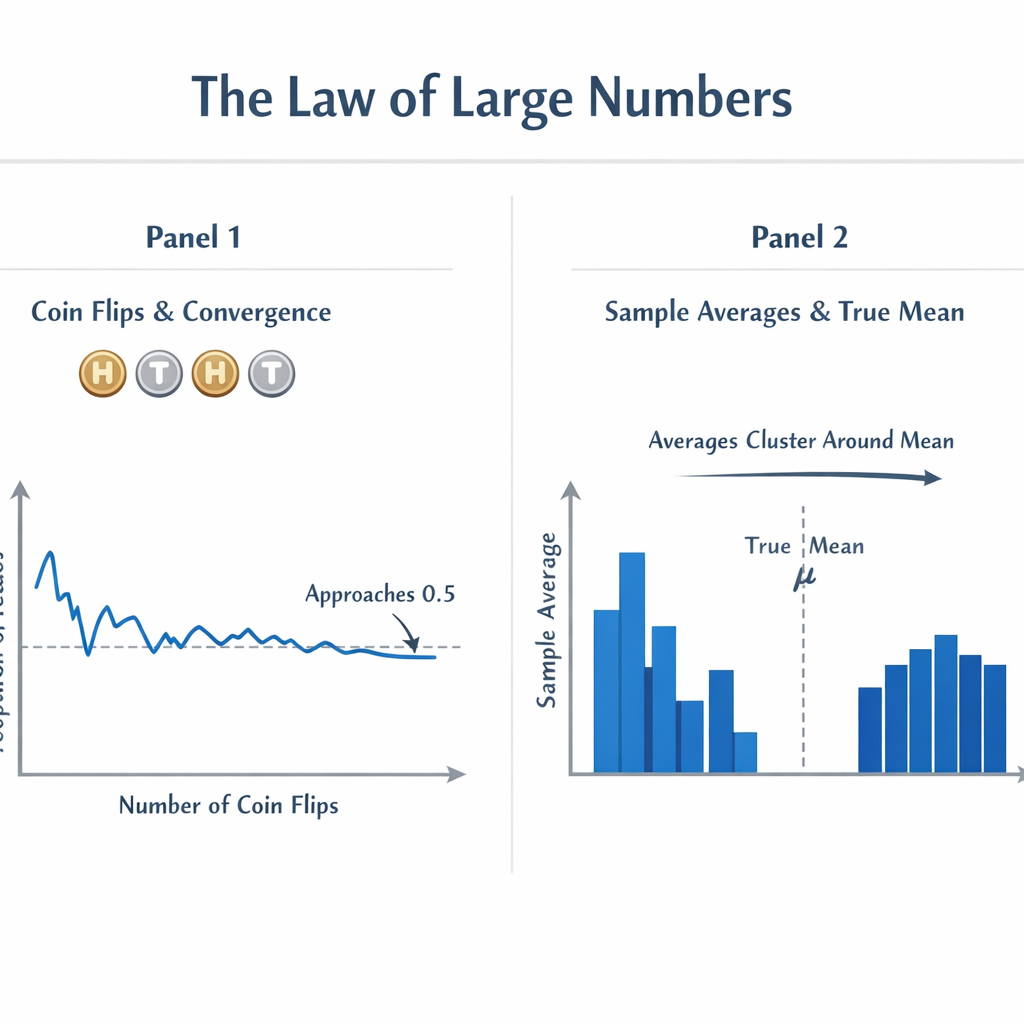
A Simple Example: Tossing a Coin
Imagine flipping a fair coin.
- In 10 flips, you might get 7 heads
- In 100 flips, maybe 53 heads
- In 10,000 flips, you’ll be incredibly close to 50/50
Each additional flip helps the average “settle down” and drift toward the true probability.
It’s like zooming out on a noisy picture—the further back you go, the clearer the image becomes.
Why This Matters in Real Life
The Law of Large Numbers quietly powers a lot of the modern world:
✔ Insurance companies
They predict risk by looking at huge pools of data. One person is unpredictable; a million people aren’t.
✔ Polling and surveys
A small sample is noisy. A big sample is trustworthy.
✔ Quality control
Manufacturers track large numbers of products to spot defects early.
✔ Casinos and gaming
The “house edge” is tiny in the short run, but the LLN ensures it shows up over thousands of bets.
In short:
Big samples → stable averages → better decisions.
Two Flavors of the Law
If you’ve heard people talk about the weak or strong Law of Large Numbers, here’s the difference—without the math.
Weak LLN
As the sample size grows, the sample average probably gets close to the true average.
Strong LLN
The sample average almost certainly converges to the true average.
Both are saying:
“Relax. The more data you gather, the more accurate your average becomes.”
A Real‑World Analogy
Imagine reading online reviews for a restaurant.
- 2 reviews? Could be extreme opinions.
- 200 reviews? You’re getting a reliable sense of reality.
- 2,000 reviews? You can bet the average rating reflects what you’ll actually experience.
This is the Law of Large Numbers in action—everyday, everywhere.
Final Thoughts
The Law of Large Numbers is one of those rare mathematical ideas that is both profoundly important and wonderfully intuitive. It explains why data stabilizes, why averages matter, and why more information almost always leads to better insight.
If you’ve ever trusted a rating, made a forecast, run an A/B test, or studied analytics—you’ve already been using it.
About The Author
